Cosmic Lighthouses: The Ultra-Dense Remnants of Stars

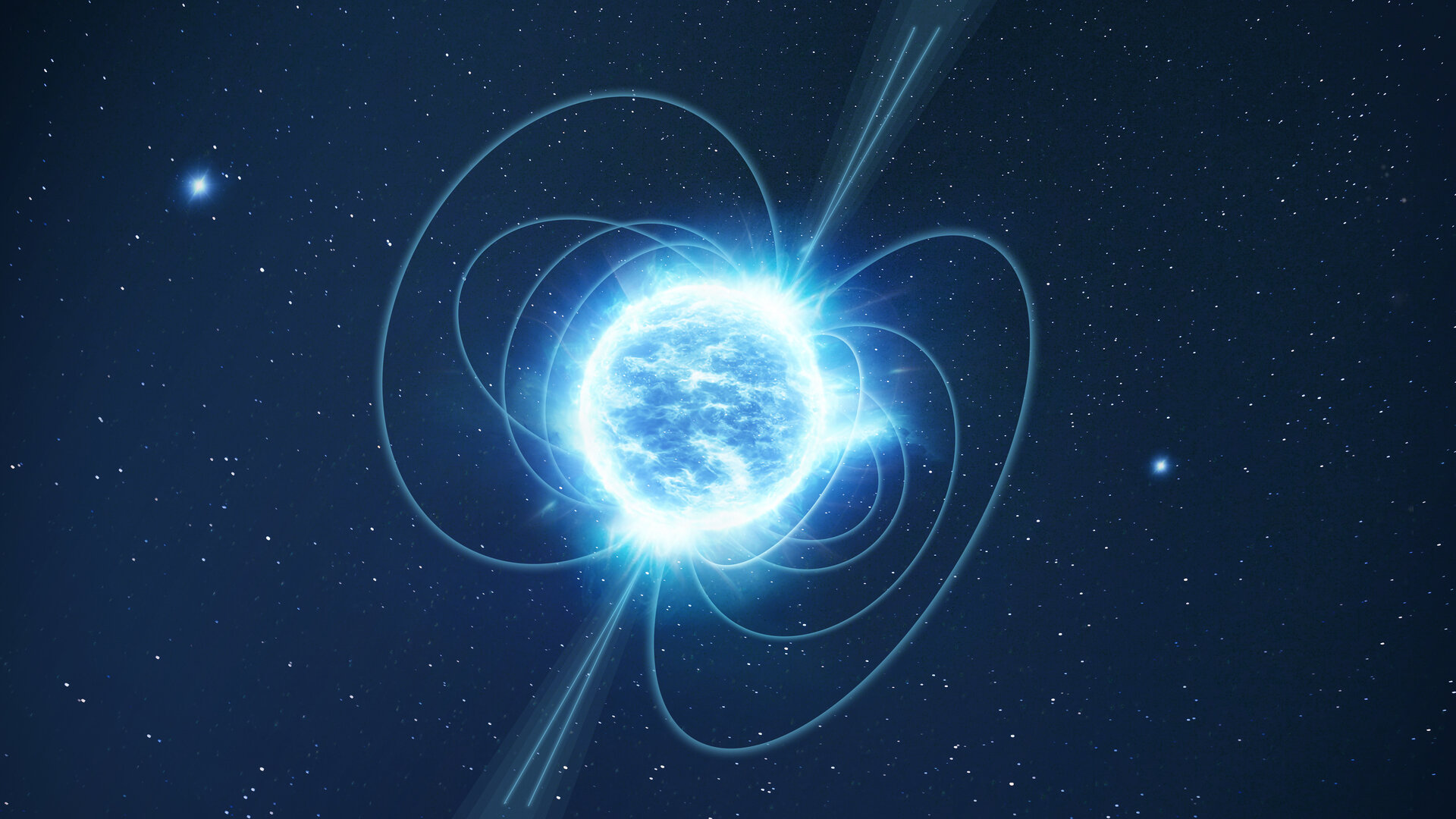
When a massive star dies, it doesn't always become a black hole. If it's not quite massive enough, its final, violent supernova explosion blasts away its outer layers, but the core collapses into an object of unimaginable density: a neutron star. The crush of gravity is so intense that it forces protons and electrons to merge into neutrons, packing the mass of our sun into a sphere no wider than a city. A single teaspoon of its material would weigh billions of tons. Many of these stellar corpses spin incredibly fast, rotating hundreds of times every second.
The Physics of Neutron Stars
The physics on the surface of a neutron star is taken to the absolute limit. If you could somehow survive the intense radiation and approach one, the gravitational force would be hundreds of billions of times stronger than Earth's. You would be instantly flattened into a microscopic film of atoms plastered onto its surface. Beyond the gravity, their magnetic fields are the strongest known, trillions of times more powerful than our own planet's. This field is so extreme it would warp atoms and make chemistry as we know it impossible.
The Lighthouse Effect
While incredibly small and difficult to see directly, some neutron stars make their presence known in a spectacular way. If the star's powerful magnetic poles are not aligned with its axis of rotation, they shoot out intense beams of radiation into space. As the star rotates, these beams sweep across space like a cosmic lighthouse. If one of these beams happens to flash across Earth, our radio telescopes detect a regular pulse. These objects are called "pulsars." The first one was discovered in 1967 and was so clockwork-regular that it was briefly nicknamed LGM-1 for "Little Green Men." Today, we use the incredible precision of these pulses to test the laws of general relativity and to hunt for gravitational waves rippling through the fabric of spacetime.